Monday, 29 June 2009

Medieval recipe: Pears in Syrup

Every now and again I have a go at a recipe from the ancient or medieval worlds, officially for research purposes but mostly through a mixture of curiosity and greed. Since I now own a copy of Constance Hieatt's delectable book of authentic medieval recipes, Pleyn Delit, this time it was one of those deceptively simple but spicy, wine-warm sweets which the fourteenth and fifteenth century loved.

The recipe calls for 1 kilo/2 lb of pears, 500ml red wine, 1 tbsp. red wine vinegar, 125 gm sugar, 1tsp. cinnamon and 1/4tsp. ground ginger, plus an optional 6-8 whole cloves and a pinch of saffron. There are several methods of cooking this fifteenth-century delicacy in Prof. Hieatt's book (recipe 113: Wardonys in Syryp), and medieval cooks would have used pots over an open fire, but I like to keep it simple, so used a casserole and a fan oven.

Parboil the pears in water for a few minutes, then peel and quarter them and lay them in the casserole. Add the cinnamon and sugar to the wine in a saucepan and heat it through until the sugar has dissolved, then strain (if necessary) and pour the mixture over the pears. Cover the casserole and leave it in the oven for about an hour at around 250C (180C in a fan oven worked fine). Remove the casserole and add the wine vinegar, cloves and saffron. If necessary, remove some of the liquid and boil it for a few minutes to reduce it, which will slightly thicken and sweeten the syrup. Put the casserole back in the oven and give it another 15 minutes or so. 'Look that it be sharp and sweet (poinaunt an dowcet)', the recipe says. Cool, serve and eat.

For more detail, more cooking methods and a mass of other recipes, see Pleyn Delit. The medieval English cook may well have used Warden pears, grown at the Cistercian abbey of Old Warden in Bedfordshire, and the abbey's coat of arms (top left, from the abbey's page at Bedfordshire County Council Archives) shows three of them. A similar dish, 'peres en confyt', includes mulberries for darkness and appears in the fourteenth-century cookbook, Forme of Cury.

Tuesday, 16 June 2009

Recent review roundup - plus an interview

Allowing myself a brief toot or two on my own trumpet:

A couple of encouraging reviews came in recently for A Knight's Captive - one from Single Titles (who also did an interview with me) and one from Manic Readers.

I've also just had a B for Blue Gold from Dear Author, so that's another toot.

That's it for now.

Friday, 5 June 2009

The past is another country...

'Stonehenge' by John Constable (from Wikimedia Commons)...They do things differently there.' (L. P. Hartley, The Go-Between)

Setting any story in the distant past brings its own delights and perils. For me it allows my heroines to be engaging and ingenious, sometimes accepting historical society's conventions and restrictions, sometimes going against them, but always provoking inner or outward conflict. Heroes can be shown off to great advantage, really doing something - protecting, rescuing, struggling with great war-horses, battling the elements or the bad guys.

However, the backdrop against which all this high-stakes, high-adventure romance takes place needs to be carefully drawn and considered. Fashions are different, right down to underwear (or lack of it). Transport, law, weapons, animals, trees, climate, customs - these can all be very different from the present.

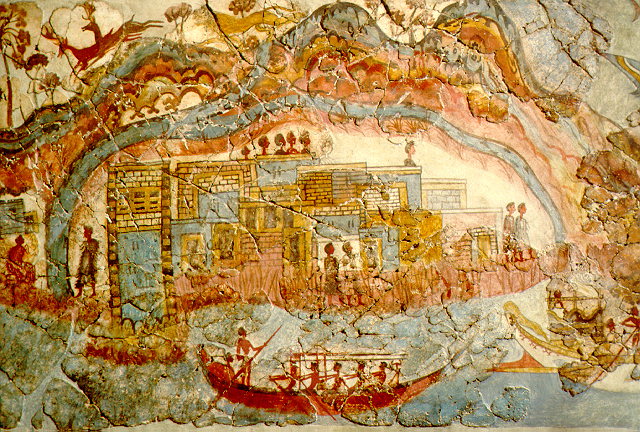
My oldest book, in both creative genesis and the date at which it is set, is Bronze Lightning. This is set in the Bronze Age, before the eruption of Thera (the modern Greek island of Santorini), the island shown below in a Bronze age fresco. Some structures, such as the pyramids and Stonehenge, were already old when the story opens in 1562 BC, although these also looked different. The pyramids I have imagined with their wonderful limestone covering, which would have made them gleam a brilliant white in the landscape. Stonehenge was also complete and not yet fallen into the decay already familiar when Constable created his painting of it.

Ritual places are not the only things that were different in the distant past. Some activities, such as the smelting of metals, farming, brewing, the making of clothes, were all different from what came later and very different from our own time.

Bronze age fresco from Aktrotiri in Thera (Santorini)(Wikimedia Commons)Beliefs and religion were also very different and, given the few written sources we have from Bronze Age Europe, must be inferred from archaeology and other means. Fearn the hero believes in a Sky God who has some characters that are similar to the later Viking God Thor: all later religions tend to have 'clues' of past faiths in them. He also undergoes a trance state where he sees symbols that modern shamans have also reported seeing in trances and which have been painted by cave painters.

In Bronze Lightning I bring the heroine Sarmatia right to my own doorstep. The winter house she lives in is set where my parents' house is now, and the wild apple and cherry trees she sees in blossom are ones I have known since childhood. Lots of other details are changed, however, because the distant past truly is another country.

In the Bronze Age, the climate in England was warmer and drier than today. There was much more woodland, and animals such as beavers, bears, wolves and wild boar in the woods. We have lost all these creatures excerpt for the boar, which has escaped from farms in southern England and is making its home in woodland again. Lime trees flourished, and orchids and other flowers that are rare or extinct today. The sheep Sarmatia care for were more like Soay sheep, that do not flock and whose fleece is not at all like the thick fleeces of modern breeds. The cattle were smaller or completely wild. Even the stars she followed were different. Even the polar star hung in a different place in the Bronze Age.

I exploit these differences to show the past in my story, to remind my readers that they are in another time, another place... where magic and romance do truly go hand in hand.

[This piece was posted as part of Classic Romance Revival's Carnival event. Contest winners are listed here:

http://www.classicromancerevival.com/blog/?p=967

A CRR free read package for the 100th lucky subscriber is still available - we are so nearly there! It could just be you! While you're at the CRR blog, look for the subscribe2 block in the sidebar, enter your email address and click send.]

Monday, 1 June 2009

The power and romance of names

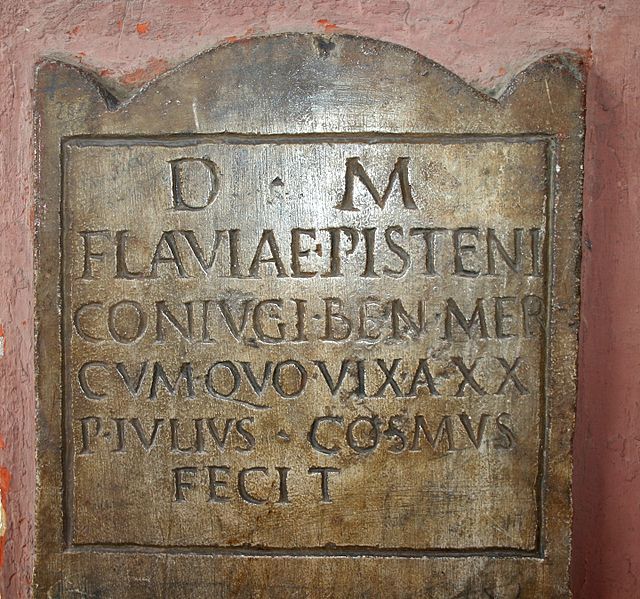
Roman gravestone made by Publius Iulius Cosmus for his wife FlaviaIn Ursula le Guin's Earthsea Trilogy, names are part of the magic and being of characters, and to discover someone's true name is to gain power over that person. Names do have power. I wonder how many sons will be called Obama in future years?

Names have power and significance in romance, too. If a hero has a bulky, awkward name, do readers empathise with him? If a heroine has an 'old-fashioned' name, does she lose credibility?

I write medieval historical romances, and I find how I name my people vitally important. For instance, in the Anglo-Saxon period, there are many names beginning with E or AE - EDGAR, EDITH, EGBERT, ELDRED, ALFRED. These names have power and meaning - EGBERT means 'Gleaming Sword' - yet they possibly have fallen out of favour. How many heroes are called EGBERT now? ARTHUR is another name that may look old-fashioned to some. The meaning of ARTOS, 'bear' is wonderful to me, though, and made me fall utterly in love with the name again.

I always try to discover if names have meanings and bear those meanings in mind as I write. For example, my heroine in A Knight's Captive is called Sunniva, which means Sun Gift. It's a Viking name, still used in parts of Britain. AVERIL is another name I would love to use sometime - it's meaning is 'Wild boar battle maid'.

As a historical romance writer I try to use names I feel are appropriate to the period in which I'm writing. Sarmatia is a real name, taken from a Kretan Linear B writing tablet of the time when Bronze Lightning is set. Ahhotpe in Blue Gold means 'The Moon is Content', which is nicely ironic, given that my Egyptian princess is very ambitious! Sometimes names cetainly can deceive. I had an anti-heroine in one of my modern romantic suspenses (Night of the Storm) and I called her Katherine, which means 'Pure'.

So names do matter, as a clue to a character's background and nature or as a key to period. I am always filled with admiration for fantasy and science fiction romance writers who devise names. Of course, sometimes names cannot be avoided: I read a good historical war-and-romance novel (The Assyrian by Nicholas Guild) and the names there - all authentic - were very difficult to me: very long and multi-syllabled.

For me, at least, some names are to be avoided!

Lindsay (it means 'Linden Tree')

Friday, 22 May 2009

I've been Kindled again...

I'm delighted to report that all my mainstream Bookstrand titles are now - like my Kensington medievals - available for the Amazon Kindle. Links are on my blog (see the book details pages), or on Amazon's own list of my Kindle editions.

Thursday, 14 May 2009

'A Knight's Captive' a keeper at Romance Junkies

Romance Junkies have given four ribbons to A Knight's Captive. Here's a little of Natalie's review:

"Lindsay Townsend's newest release, A KNIGHT'S CAPTIVE, takes place in England just months before the Norman invasion. Readers will be mesmerized by the hero, Marc, and Sunniva, the woman who captures his heart.

... Lindsay Townsend and her wonderful characters didn't let me down. The love that Marc and Sunniva had for each other finally culminated in a relationship that was almost blessed. A KNIGHT'S CAPTIVE by Lindsay Townsend is a keeper in my book. I can't wait to read it again."


The full review is here.