Wednesday, 7 April 2010

Women and alchemy

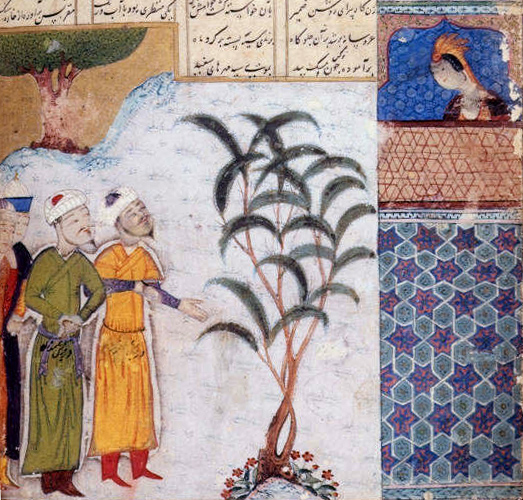
Miryam and the alchemists, from 'The Khamsa', a 12th. century series of Persian poems by NizamiEveryone knows that alchemy is the art of turning base metals into gold. It was also seen as a pursuit of divine knowledge and immortality. From its very beginning in the ancient world, alchemy was seen either as a glorious search for truth or as a means for charlatans to hoodwink money out of gullible patrons. Such dabblers in the art were known unkindly as 'puffers' - from the bellows often used in alchemy in the heating of substances - and were despised by the more serious students of alchemy.

In my forthcoming A Knight's Enchantment the heroine, Joanna, is an alchemist. From earliest times, when the strange ‘science’ of alchemy developed, women became alchemists. They were as respected as men in this profession and several were particularly revered. Many powerful and influential women studied alchemy, including the countess of Pembroke Mary Sidney, Queen Christina of Sweden and even Marie Curie.

Why were women drawn to alchemy? Famous and successful alchemists tended to be long-lived - usually far longer than the average life-span. That and the prospect of riches may have drawn some, though alchemical thinking also attracted the religious and mystical such as Hildegard of Bingen. In part, too, women may have been intrigued by alchemy because they were accepted and respected in it. The feminine principle was acknowledged in alchemy - many saw nature itself as female and today doctors still used the alchemical symbol for copper, a soft, malleable metal, for woman.

Women were also given credit for their alchemical work and inventions. One of the most famous, called the 'Mother' of alchemy, was Maria the Jewess, who lived in the first or second century AD, possibly in Alexandria. She recognized the importance of changes in color in chemical and alchemical reactions and is credited with inventing a still used for distillation and also the balneum mariae (bain-marie); a water bath that is kept at a constant heat via a kettle or cauldron. A contemporary of Maria was Kleopatra, who likened the growth and progress of alchemical work to a baby growing in a womb.

Woodcut of Nicholas and Perenelle Flamel (pic: Wikimedia Commons)Women could also be married to alchemists and help them in their work. Nicholas Flamel, a famous medieval alchemist who lived for a time in Paris, was assisted in his work by his wife Perenelle and, when their experiments in alchemy brought them wealth, they jointly founded hospitals.

When so many professions were closed to women in the past, perhaps it is not surprising that some chose to pursue this most secret and at the same time most fascinating of arts.

[Colour picture from The Alchemy Website, others from Wikimedia Commons.]

Bookmark and Share

Wednesday, 31 March 2010

Having a quiet Easter...

It's Easter Bunny time. Our model today is Smokey, a Netherland Dwarf, one of a long line of rabbits owned and cared for by my nephew Tom Underwood down in Devon.

Apart from being healthy, inquisitive and housetrained, Smokey clearly had immaculate taste in reading. On the top shelf are some of my English editions, including Chasing Rachel, which is coming out again this year in a revised download from Bookstrand.

In fact, the edits for Chasing Rachel turned up this morning, so I know how I'm going to be spending Easter. It has to be more relaxing to be a bunny.

Bookmark and Share

Tuesday, 30 March 2010

Carols and capering: medieval dance

Four husbands into her career, Chaucer's Wife of Bath was still young and a lively soul, 'yong and ful of ragerie,/Stibourn and strong, and joly as a pie [magpie]./How koulde I daunce to a harpe smale,/And singe, ywis, as any nightingale,/Whan I had dronke a draughte of sweete wyn!' So how would she have danced?

Dancing in circles has gone on for who knows how long, and the medieval carol - a circular dance and the songs that went with it - was popular with everybody but the church. The songs, involving a leader who sang the verse, music from harp, pipe and tabor or the vielle (a predecessor to the violin) and the dancers providing the chorus, could get distinctly rowdy, and clerics could impose sanctions against those who moved in an unseemly fashion or sang colourful lyrics in churchyards.

The lyrics from early carols are hard to come by, but one popular carol from the thirteenth century, Angelus ad virginem, whose English version begins 'Gabriel fram Heven-king/Sent to the maide swete', has a bouncy tune ideal both for accompaniment with pipe and tabor and for the circular carol-dance. The music can be heard here, and possible steps have been suggested here.

Many dances thought of as medieval - such as the basse danse, branle and pavane - really belong to the Renaissance, when the first collections of dance music were made, but we can trace some formal dances like the saltarello, with its triple time and extravagant hop, back to the thirteenth-century.

If a solo dancer or tumbler took part in social dancing, there could be some seriously gymnastic capering. The sight of women dancing on their hands may have led to an emphasis on modesty in later instruction books such as Guglielmo Ebreo's fifteenth century Art of Dance, but in earlier times things were more freewheeling. A poem from the Benediktbeuren Manuscript of c.1230 ('Obmittamus studia') has a young student longing to abandon his lessons and go down into the street to watch the maidens dancing, 'white limbs moving/Light in wantonness,' as Helen Waddell translated it. Now that would have appealed to Chaucer.

Bookmark and Share

Tuesday, 23 March 2010

Prisoners in the castle: dungeons and oubliettes

The oubliette at Warwick CastleMedieval castles and dungeons tend to go together in people's imaginations and I have set important scenes in A Knight's Enchantment in a dungeon, where the heroine Joanna's father is being held. What we imagine as a typical dungeon, however - dark, underground, no windows, lots of chains - was less common in the Middle Ages than is assumed.

Take the word 'dungeon'. Its earliest form, donjon, meant a keep or tower, a strong defensive position. Over time that tower has been taken to mean a prison, often
underground in a castle. This form of prison was in fact an oubliette (meaning 'forgotten place') and was far darker and more grim than a dungeon, as can be seen in the photo of the oubliette in the castle at Warwick.

Famous dungeons include the Tower of London and those at Pontefract Castle and Alnwick Castle, though true dungeons in castles were not usual until later in the Middle Ages.

Often noble prisoners, captured and held for ransom in the dungeon, would be kept in a secure, comfortable place within the host's castle: certainly the room would be well-guarded, but we should not picture a Richard the Lionheart or Charles of Orleans languishing in the rat-infested, damp stone cell of imagination. Life expectancy in an oubliette would be short, and bad for the ransom business. 'Common' prisoners might be kept in gate houses, while those considered undesirable and disposable but not to be actually murdered could end up down with the rats in the oubliette.

Bookmark and Share

Friday, 19 March 2010

DABWAHA 2010

Having been away for a while, I only discovered this morning that Blue Gold was chosen to participate in DABWAHA 2010, run by Dear Author and Smart Bitches, Trashy Books.

Whatever happens, I'm delighted to be nominated in some very strong company. If you want to take part in the voting, here's the link.

Bookmark and Share

Tuesday, 16 March 2010

Here's the latest

Time rushes by! A Knight's Enchantment will be in the bookstores in late May/early June, which is not so far away now spring has sprung. To introduce the hero and heroine, I've posted a chunk from chapter one as an excerpt and you can read it here. I've also now sent off my fourth knight novel to Kensington, called A Knight's Prize.

In that connection, I'm working on a short blog about medieval dancing that will appear at the end of this month on Unusual Historicals.

There's an All Romance Ebooks party coming up and I'm offering Flavia's Secret as a door prize.

The audio version of A Secret Treasure comes out on April 12 from Audiolark and an electronic edition of my contemporary romantic suspense set on Dartmoor, Chasing Rachel, will be coming out some time this year from Bookstrand. More about that when I have it.

Bookmark and Share